by Bob Chadwick
The following is excerpted from Bob Chadwick's Learning Manual 3, Managing Scarcity Conflicts, which is the report from the Consensus Institute at the Colville Confederated Tribes, state of Washington, USA.
A Consensus Institute is a series of three-day, skill-building workshops on managing conflict and change, power, scarcity, and diversity.
The reader should be aware that these manuals outline a process which cannot be simulated, but only described and outlined, on the printed page.
In each session, grounding and greeting circles are used. For a summary, see Beyond Conflict to Consensus.
ABOUT THE REPORT: In this installment, the statements of the participants have been left out. The questions that outline the process are in bold. What is left are the "consensus seeking and community building insights." As Bob Chadwick explains:
"Consensus seeking and community building insights are inserted into the report at the time they were presented. The process is defined as the report progresses. Reading this report will allow the participant to re-experience the session, and to recall the beliefs, the process, and the art for seeking consensus."
This module introduces the participant to the skills, attitudes, and understandings needed to manage behaviors and conflicts that result from moving from an environment of plenty to one of scarcity. The participant will learn to:
- help others recognize and acknowledge the behaviors that result from scarcity
- develop the ability to identify and ask the right question
- make decisions that create a richness in the environment, that allows others to move from their worst fears to identifying and affirming the outcome they want.
A panel of four people presented their view of the financial situation confronting the Colville Confederated Tribes and in their environment. This can be external and/or internal to the Tribe.
THE QUESTIONS:
What is the financial situation confronting the Tribes, or yourself in your environment?
How do you feel about it?
The participants then formed four small groups, facilitated by the panel members and answering the questions:
What did you hear or learn from the panel?
What is your view of the financial situation confronting the Tribes?
How do you feel about it?
After listening to each other, the participants wrote down the two pieces of evidence they heard from others that there is scarcity in the environment on a 3-by-5 card.
What is the evidence of scarcity in the external/internal environment you heard from others?
These statements were then recorded. The recorded statements were developed into collective statements.
This task makes each member responsible for listening to the panel and learning. The panel is always honored by reflecting on what was learned, first. Then each person provides their view of the situation. Writing down the evidence makes the members responsible to create a common knowledge base. It introduces silence, balancing each person's internal energy.
They are introduced to the scarcity concept by identifying the scarce resources in their environment. This brings their thinking and feeling into the arena of "scarcity." A chair was removed from each group so that a person had no chair. This brought scarcity into the task.
While there is ample evidence of scarcity in the participants environment, there are also behaviors that indicate people believe there is still plenty. This is important information, and an important incongruence to acknowledge.
People in the community feel betrayed if they are asked to respond to scarcity, yet they see the Managers or the Tribal Council with plenty. At the same time, the Managers or the Tribal Council see evidence that the community can provide more support. The behaviors of plenty result from a continuing denial of scarcity, a belief that we will be "rescued" by someone else.
While the groups worked on this task a second chair was removed from the group, increasing scarcity.
What is the evidence that tribal managers think there is plenty?
(What is the evidence the community members can provide more support? External)
Worst possible outcomes of confronting/
not confronting the issue of scarcity
The small groups explored the worst possible outcomes of not addressing, confronting or adapting to the issues of scarcity.The worst outcomes affect the beliefs, strategies and behaviors of the group. They affect relationships so that information exchange is severely hindered. This actually may foster the worst outcomes of an issue.
These worst outcomes are possible. They are probably present, at some level, in the environment. They create the reactive force that develops the actions, strategies and behaviors of the participants. They often describe the existing situation from the parties'viewpoints.
While the group was given this task, two more chairs were removed, increasing the scarcity of seating.
What are the worst possible outcomes of not addressing, confronting, or adapting to the issue of scarcity?
What are the worst possible outcomes of confronting or adapting to the issue of scarcity?
The beliefs and behaviors in times of scarcity
The participants observed, and experienced the behaviors that are created by moving from plenty to scarcity. This is done in two steps.The first step occurred as the participants worked through the tasks on the evidence of scarcity, the evidence of plenty, and the worst possible outcomes of scarcity. Before each of these tasks the groups were advised the one or two chairs would be removed from each group. These are used for another activity. The groups were then given the tasks to answer and record.
The reaction of the groups to this differed.
In some groups, the people who lost their chair stood, or sat on the floor.
Other groups put their chairs together, and shared them so all could sit. This brought them closer together.
Others tried to get a chair from another group, or went to find an extra chair, increasing their resources.
The interesting behaviors to observe are:
Since they had a task to do, they all went on with the task and completed it.
Doing the task kept them focused on it and not on the scarcity.
All groups adapted to the scarcity.
There is a lesson in this. If all groups lose the same amount of resources, they will not compete with each other. If all groups have the scarcity decision made for them, and they accept it, they can focus on their task. If they focus on the task and not on the scarcity, the task is completed while they adapt to the scarcity.
If the resources had been taken from one group only, they would have complained and tried to take a chair from the other group. This would have resulted in defensive and protective behaviors in all the groups. This would have disrupted the focus on the task for all the groups.
If the groups were asked to decide which person's chair should be removed, then a struggle for survival would have ensued within the group. People would feel threatened, in conflict, protective and greedy. This would have prevented the group from focusing on the task.
A scarcity experience
The second scarcity experience uses the chairs removed from the group. A variation of musical chairs is enacted. The experience begins with the chairs (supply) outnumbering the people (demand). Before the task is complete the chairs (supply) are outnumbered by the people (demand).There are different behaviors in times of plenty and in times of scarcity. The experience allows the observers to see those different behaviors in transition.
STEP 1. The chairs removed from the group are arranged in a circle in the middle of the room, with the seats pointed inward.
STEP 2. A representative is selected from some of the groups. The number of representatives selected is less than the number of chairs. (I.E. 6 chairs, 4 representatives.)
STEP 3. The representatives are instructed that they need one chair to provide adequate resources for their group. They must be seated in the chair to own the resource. Any part of their body touching another chair gives them access to that as a resource. This is known as "bringing home the bacon."
The representatives are to walk around the outside of the circle of chairs while music is played or sung. When the music stops, then they must obtain their resources.
STEP 4. Two or three people have been selected in advance to sing songs for the exercise. They choose the songs, and sing them until I signal them to stop.
The representatives dance around the circle of chairs until the music stops, and then rapidly, with little decorum, grab a chair, and as much of an extra chair as they can. Their group applauds. This is the first allocation of plenty.
STEP 5. Because they are so effective, the representatives are rewarded with another chair (increased resources). Step 4 is repeated. Again, the representatives, with much energy, grab all they can get. Laughter and applause acknowledge their aggressiveness. The participants are asked to talk about how they feel about this situation of plenty. (7 chairs, 4 participants)
STEP 6. Another chair is added to the group. The Government has decide to reward the Tribe for the job they are doing, and is asking them to do more. A person is selected from another group to represent the "disenfranchised... the old, the poor, the handicapped." This person sits in one of the chairs and does not have to do the dance. He is being treated "magnanimously" in this environment of plenty. (8 chairs, 5 participants)
STEP 7. Step 4 is repeated, and the representatives now fight to get more than two chairs. Occasionally a member will lose out and not get a chair. Or, a member will not like the "greediness" and will refuse to grab as the others do. This member is sent back to his group for instructions. We wait until he returns.
STEP 8. Another person is selected from a group. No chairs are added. There is a need for more people, but there are no more resources. Still, the resources outnumber the demand. Step 4 is repeated. An increase in energy and apprehension is observed for the first time. If a person does not get a chair, they are sent back to their group for instructions. (8 chairs, 6 participants)
STEP 9. Another person is added, and 2 chairs removed. More people are needed to do the job, but the resources are lessened because of scarcity in the financial environment. (5 chairs, 7 participants)
Step 4 is repeated. The people are now fighting for the chairs. Some end up sitting on each others laps. Some share chairs. Some are left standing. These return to their group for more instructions on how to "bring home the bacon."
Normally, at this point, the representatives complain about the person who is disenfranchised not having to dance to the tune. They feel this is unfair. They may even try to wrench the chair away from him.
STEP 10. The disenfranchised is told to stand as the rest of the representatives. His chair is removed. There are no longer funds for these special programs for the needy. He must dance with his eyes closed since he is handicapped. Another chair is removed because of scarcity. (4 chairs, 7 participants)
Step 4 is repeated. The dance is done slowly, each person holding onto a chair as they go by, trying to pick up chairs, or jumping into the circle before the music stops. The struggle for the chairs is intense.
Only three or four representatives are seated. The others are angry. The handicapped person is lost. They feel left out, embarrassed in front of their group.
STEP 11. Step 10 is repeated to give those standing a chance to redeem themselves.
STEP 12. The representatives are asked to express how they feel about each other, how they feel about scarcity. Some members of their groups join in.
I ask the group: "Who is calling the tune?" It takes a few moments of silence before someone points to me. I ask them why they dance to my tune, why they give me this power?
STEP 13. The representatives are asked to solve the scarcity so that all share the resources. Normally, and almost immediately, they put the chairs together to create a platform so that all can be seated.
STEP 14. The representatives are asked to solve the resource problem without the chairs. They need to share the resources. They normally form a tight circle, standing or sitting.
STEP 15. The representative and the singers are honored by the group for playing this important learning role for the entire group.
STEP 16. After a break, the groups are then reformed and given the learning task. They are asked to describe and record the beliefs and behaviors they observed in times of plenty, and then in times of scarcity.
The beliefs and behaviors of plenty and scarcity
This is the learning task. After observing the members in the scarcity experience, they become aware of the beliefs and behaviors that are associated with plenty and those that result from moving to scarcity.Because scarcity is a new situation, there is denial and disbelief. There has always been plenty in the past. We validate that by giving examples of how the Council, CTEC, or others, are still behaving as if there is plenty.
This belief that there is still plenty based on others' behaviors makes us feel taken advantage of. We use this to justify the selfish and disrespectful actions we take in the scarce environment. We are just trying to get our share. If they are selfish and greedy, then we can be too!
Once people are convinced there is a true scarcity, that it impacts them all, they can take decisive action that is respectful and focused. They will adapt. This task is intended to convince them.
What are the beliefs and behaviors that you observe in times of plenty?
What are the beliefs and behaviors you observe in times of scarcity?
A stereotyping experience
The participants are re-introduced to the evidence of the scarcity situation with a panel of five selected individuals. These individuals have been asked to represent different viewpoints; CTEC; the Tribal Council, The BIA; the membership and the Departments. Each panel member played a role and presented their view of the financial situation from that role perspective.What is your view of the financial situation you are, or have, confronted in your environment?
How do you feel about it?
In answering the questions, the panelists are encouraged to make the situation as real as possible. It is not unusual for the role players to interrupt each other, or trivialize each other's statements as happens in real life. This adds some realism to the task. This activity creates the arena of discussion, as well as setting the stage for "Group Think" and the stereotype task.
The listening participants were directed to choose a role to represent that was different than their normal role. They formed five small groups with like roles and answered the questions:
What is your view of the financial situation (playing your role)?
How do you feel about it?
The participants immediately recorded their view of the situation. The panelist served as a facilitator and encouraged his group to represent themselves. They were allowed five minutes for this task. This time limit has the benefit of increasing the energy level of the group, and developing a sense of urgency and groupness.
After recording their statements, being sure to allow each person in the group to speak, the groups reported their information to each other. The groups are encouraged to interact as the presentations are made. By now, each group has a sense of unity, and they protect their groupness and pride.
The worst possible outcomes of scarcity
The groups are asked to represent their worst outcomes from the roles they are representing. They are allowed 4 minutes to do this. Again, time is reduced to increase the sense of urgency and competition between the groups. This reinforces the group think, encourages emotional response and discourages rational thought.What are the worst possible outcomes of scarcity?
Exploring stereotypes
The small groups explored the roles and stereotypes that exist between groups. These stereotypes are the worst outcomes of personal relationships, and result from the perception of scarcity, conflicting values, and the belief that the "other" is a potential "enemy."They result from operating out of the worst outcomes of the situation. They are often negative, and often magnified. They strongly influence the beliefs, behaviors, and strategies of the individuals who have them. They affect relationships so that information exchange is severely hindered, and may foster the worst outcomes of an issue.
As part of this task, we also explored the stereotypes we know others have of us. These are also negative and often magnified. We know others see us negatively, and this affects our behaviors. Then, we explored the stereotypes we have of ourselves. These are positive, and somewhat magnified. We all think of ourselves as "good people." These positive views are overcome by the negative stereotypes others have of us, and that we know they have.
The groups begin by defining "stereotypes" to move their mind into this arena of thought and feelings. For example:
A stereotype is a generalization. If you have seen one, you have seen them all. It is judging a group of people, by one person. There are individual perceptions that are swayed by prejudice.
With stereotyping, you are guilty by association. People get classified into categories such as "the only good Indian is a rich Indian," or "Indians are drunks." It is the belief that groups of people all act the same.
People thing they are better than you and they are the ones doing the stereotyping. Stereotyping is a learned behavior. It is labeling without knowing. There is a lack of knowledge, by hearing, and not seeing.
The purpose of the stereotype task is to explore how we develop and use the worst outcomes in our relationships. We began by creating diverse groups who face scarcity. The members of the groups immediately create a sense of belonging, and are able to disagree with and ridicule the other group's view of the situation. They create a sense of community and a sense of purpose around defeating the "common enemy."
In this task, we selected eight groups to create the stereotypes. Then, the groups'representative presented the stereotypes to the other groups.
It was fun...in a way. But then, competition and fighting are always fun. And we all got a chance to say the things we have always honestly wanted to say. And...they were all negative!
Oh, there were some positives thrown in for good measure, but they were essentially negative stereotypes. The only time we see positive stereotypes is when we describe ourselves.
The film, "Productivity and the Self-Fulfilling Prophecy" brings the message home:
We create our world through our beliefs.
Our words,
thoughts,
images,
emotions,
create our world,
and others'.
If we think negative thoughts
have negative images
about the other person or group
then we will find the necessary information
in their behavior to affirm it.
If we think we can, or we think we can't, we will be
right either way!
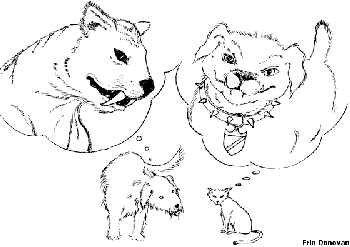
This is because we have a filter in the reptilian center of the brain which only lets in the information we program it for. We program it with our words, our self talk, the images we perceive, the emotions we are experiencing.
This part of the reptilian brain will not let in any information that disagrees with our beliefs. To do so would make us insane. If I believe that you threaten me with your presence, then I will observe only those movements and behaviors in you that will be seen as threatening. To not do so, would be to relinquish survival.
If we are in a perceived scarcity or conflict situation where someone must lose, then the battle that ensues assures that we will be enemies. We are able to create all the necessary negative stereotypes to affirm your "enemyness" with those who believe as we do, our "group think."
Our intelligence is used to reinforce this stereotype and to prove our rightness instead of being used to solve the problem. The result is the negative outcomes that we feared. After all, that's what we wanted, isn't it?
In order to turn this around, the worst fears need to be acknowledged, and then the positive possibilities affirmed.
 |
A pathway to consensus
All events or issues have a potential worst or best outcome. Either is possible. Typically, some of us choose to focus on either the worst or the best outcome (pessimists and optimists). When these views become pitted against each other, we tend to see the worst outcome or the best outcome as the exclusive possibility. This results in polarization of views.Consensus recognizes the possibility of the worst and the best outcome.
To seek consensus:
Acknowledge the worst outcome possibility. It is possible! It can happen! We all fear the worst. It's a way of being aware of potential dangers and prepares us for survival from these risks. By acknowledging the possibility of the worst outcome, we create the possibility of overcoming it. It focuses the positive efforts of people into overcoming obstacles.
Affirm the best possible outcome. It is just as possible. It's a way of expressing the potential in any event or issue. It's a goal, a direction, that all can agree to seek. It focuses the positive efforts of people seeking the best. It requires people to grow to seek the new solution.
What can we do to make the best happen? Now the group can begin to entertain the possibility of the best outcome. This gives a sense of movement, of action, of control. Each solution is right, each is necessary, as we seek to create the future we want.
What are the conditions for moving ahead? We commonly agree on goals. We disagree on how to get there. While all of the "how tos" have a common end, each person seeks to do things in his/her way.
If an approach is agreed to, the conditions for moving ahead encompass the wants of each person in the approach. This enriches a solution.
In focusing on the worst/best, it helps to deal with the worst first. This is because the fears, or negatives, are more powerful--they are concerned with survival. Once survival is addressed, then the potential of the best is easier to focus on.
How can we make the best happen? Often the answer is, "I don't know!" especially if the situation is extremely stressful or new. If so,
Acknowledge: I don't know. There is nothing wrong with that. In times of rapid change, in times of stress, the old answers just don't fit or work, so why use them? Seek another way. Acknowledge "I don't know how to deal with this situation." This is a signal from the left brain that it needs help.
Affirm: and, I want to know. Because...you do, don't you? (If you don't, then go back to "I don't know," and add "and I don't want to!") If you affirm wanting to know, you tap the creative potential of the right brain. The mind will not rest with the unfinished business. This opens up the possibility of new ideas, creating new pathways in the mind, creating the new potentials, so that you can prevent the worst and seek the best.
Allow some time for new ideas to come. Go play tennis, or have a cup of coffee, or just take a break. Solutions will form and express themselves to you. (After affirming that you want to know, it helps to also mentally affirm "trust myself.")
The perceptions and roles we will foster from our richness
At least part of the relationship problem between the different groups consists of the differing views and expectations we have of each other. We often have expectations of other groups that are different than their expectations of themselves, and they have different expectations of others than they have of themselves.When perceived scarcity exists in resources, then the others are seen in their worst possible light. They are seen in their weaknesses rather than their strengths. They are seen as "taking away" rather than adding to. The result is that the community trivializes itself, reduces its perceptions to the lowest common denominator.
Only rarely do we discuss, or explore the expectations that we can have of each other. Rarely do we explore the strengths, or the "richness" that we add to the situation. What is it that we "add to" the situation?
In this task we explored the positive stereotypes, the expectations, roles, or perceptions, we will need to have of each other to resolve the issues. We describe the "richness" that each group brings to the situation.
The question: What is the richness each group brings to the situation?
Managing stereotype possibilities
In the stereotype task we learned that each of us has negative stereotypes of each other, that we know of these negative stereotypes, but we have positive stereotypes of ourselves. It looks like this: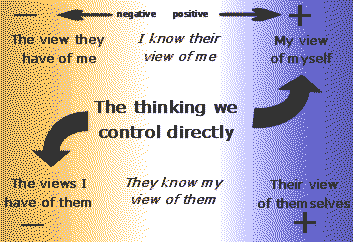
|
Notice that all the views are negative except with our view of ourselves. When we are asked to describe us, we can really "shine" on how positive we are. But, when alone, when talking to ourselves, we have this negative image that confronts us internally. So, we see ourselves as both negative and positive.
There are only two places in this relationship diagram that we have control over: The views I have of them (the Pygmalion effect) and the views I have of myself (the Galatea effect.) I can change either. That is all I control. I cannot control, or immediately impact their views at all.
I can decide to see the good in them, just as I see the good in myself. I can foster the good in me, just as I can foster the good perception of them. That doesn't assure me of a changed relationship or situation, it just provides the opportunity for this to happen. Time and experience will determine the outcome.
Positive expectations can be developed for relationships as "positive stereotypes." These best outcomes of relationships can affect the beliefs, strategies, and behaviors of the groups. They can affect relationships so that there is an open and honest information exchange which may foster the best outcomes of an issue.
Developing these positive perceptions creates an opportunity for a "paradigm," or belief, shift which can positively affect the relationships of the parties.
But, it is "I" who must change my views of others, if there is to be change. I cannot get others to change their view of me unless I begin to acknowledge the possibility of their positive stereotype.
The question: What are the positive perceptions you will create of the others based on the richness they bring to the situation?
Creating stereotypes--a process
This process is inserted in the change process, after the exploration of the worst possible outcomes of the situation.Step 1. After reading off their definitions of stereotype, the groups are directed to record the stereotypes they have of the other groups. These are the descriptors the group uses to describe the others when they get together.
The group is directed to get a clean flip chart sheet, dividing it in half, down the middle. On the left side they write the stereotype of one assigned group, and on the right side they write the stereotype of another assigned group. This is their "group think" view of the "enemy." They are allowed two minutes for each stereotype.
The question: What are the stereotypes you have of (name two groups) when you get together and talk about them? (2 minutes each.) For an education district, the groups might be assigned like this:
Support staff: principals, students
Teachers: parents, legislators
Board: senior citizens, support staff
Principals: support staff; parents
Legislators: educators, board of education
Parents: principals, legislators
Students: adults, senior citizens
Senior citizens: students, teachers Step 2. The groups are directed to move to another clean flip chart page, divide it down the middle, and record the stereotypes they know the others have of them on the left side.
The question: What are the stereotypes that you know the assigned groups have of you? (1 minute)
Step 3. The groups are directed to record the stereotypes they have of themselves on the right side of the flip chart.
The question: What are the stereotypes you have of yourselves? (1 minute)
Step 4. The groups are directed to select a representative to speak to the other groups. This person takes the chart with the stereotypes created of others and brings it with him/her to the center of the room where there is a circle of chairs facing each other. The members of the group are asked to stand behind their representative seated in the chair and root for them.
Step 5. Each representative is allowed to express the stereotypes his group has of the other groups, in turn. The confrontation is done knee to knee and face to face. Voices are raised with harsh and judging tones. The groups respond with support or with derision. There is a lot of uncomfortable laughter. Often, the person reading the stereotypes of a group, belongs to that group, but is playing the role of another.
Step 6. When all groups have read their stereotypes to each other, the representatives are directed to read them all at the same time. The supporters are encouraged to chime in. The result is a large group of people talking at the same time, their voices raising to screams, with some representatives standing for effect, others making threatening gestures. It is mayhem and chaos. This is allowed to proceed until the voices are loud and the energy is intense. Then the process is stopped.
Step 7. The following points are made for the group when their attention is gained:
Have the members sense the energy in the room. There is a lot of excitement and emotion in this kind of conflict and confrontation, in a negative sort of way.
I point out to the participants that I never asked them to develop negative stereotypes, yet that is what they created.
Someone will state that stereotypes are always negative. I have them read the stereotypes they created of themselves and they see that these are all positive.
The stereotypes they created of others are negative, and the stereotypes they know the others have of them are negative. The stereotypes they have of themselves are positive.
I point out that the groups, being diverse, know all the stereotypes they have of each other, they are not hidden, although they are rarely openly expressed to each other.
These stereotypes are the images they create of each other in the minds of the public when they speak to them. Would they be willing to invest in people with these images?
The concern is not that they have stereotypes, but that they speak about them to others, rather than to them. There is a dishonesty and disrespect shown.
These images create the self-fulfilling prophecies that are so destructive to the mission of the group.
The task ends with a film "Productivity and the Self-Fulfilling Prophecy: The Pygmalion Effect." CRM Films, 2233 Faraday Avenue, Carlsbad, CA 92008-9829 1-800-421-0833. This film is most effective when there is a learning experience preceding it on stereotypes. It allows the participants to relate the film to their own actions.
The possible best outcomes of adapting to scarcity
The groups explored the best outcomes of confronting and adapting to scarcity. This allows the participants to express their intended outcomes. It establishes what they want, a vision that will create new beliefs, behaviors, strategies, and actions that will foster the desired outcome. These changes affect relationships so that information exchange is facilitated, and this may foster the best outcomes of an issue.These best possible outcomes are developed for a short term (2-4 years) and long-term time frame (7 generations). These best outcomes are possible. They have probably been experienced at some level in the past with all participants. They are probably present, at some level, in the environment. They create the proactive force that develops the actions, strategies, and behaviors of the participants.
This collective statement provides a vision that can be developed into a consensus statement. The headlined statements are used to develop a summary that is a shorter, more focused statement. Either can be used for developing the consensus.
The question:
What will be the short term best possible outcomes for the tribes when we tap our richness in confronting and adapting to the scarcity?
What will be the long term best possible outcomes when we tap our richness in confronting and adapting to scarcity?
Exploring strategies to create richness out of scarcity
Managing scarcity requires asking people to do the impossible, that which they say they cannot do. Remember, just because I say I can't do it, doesn't make that a fact. My statement expresses a possibility, one based on the worst possible outcomes.To do the impossible, a person must stretch their "bubble of beliefs and knowledge." They must first be allowed to explore their worst possible outcomes of doing something they say they can't do. Once this is acknowledged, they can explore and express their best possible outcomes. This forms the basis for creating strategies that focus efforts toward the best outcomes.
In the following tasks the groups explored a number of different approaches:
Creating a paradigm of "richness."
Exploring how to tap the richness of others, of the situation.
Changing the situation from one of "cost" to one of investment, and exploring the conditions for making the investment.
Creating income from the situation.
Creating a surplus through investment decisions.
Each of these strategies may not, in themselves, solve the problem of scarcity. They will stretch the imagination and beliefs of the parties so they can consider new and creative approaches to resolving their scarcity situation.
The politics of scarcity
Perceptions of scarcity arrived in the 1960s--a fear there wasn't enough to go around. Scarcity is with us now in full measure: old growth, wilderness, quality of life, clean water, endangered species, budgets, markets, natural resources, jobs, time.Allocation decisions are different when there is perceived surplus. When supply exceeds demand, the politics of distribution focuses on the distribution of that surplus. If there are eight pieces of pie and six people we want to distribute to, the allocation of surplus pieces is done with compromise as the accepted process. If we do lose some of the surplus, it's not really that important except as a matter of pride. It's a fun, competitive game. Sometimes we even magnanimously share a portion of the surplus with those who have done without. That's what we did until the 1960s.
With scarcity, it's different. If there are eight pieces of pie and ten people to distribute to, we are now talking about not only allocating the original surplus, but also a portion of my piece. In the politics of redistribution, compromise is viewed as a losing proposition for everyone. This sets up conditions that make the others the enemy, with the creation of appropriate stereotypes and the hardening of positions. Now, our intelligence is used to defend our position, and affirm the negative qualities of the enemy. We are at war and it's no longer a fun game.
Compromise will not work in this situation, because the result is either win/lose or lose/lose. In this situation, consensus provides an opportunity to solve it by creating new contexts.
In urban renewal projects, you know that as the blocks are razed, a group eventually forms to save the last remnant of the architecture. It is a normal response. That is why environmentalists are so successful. They attribute unique qualities to the resource they are protecting--the last old growth stand, the last untouched stream on the east side of the mountain, or the last place to find solitude adjacent to the city.
Either/or
We typically think in "either/or" terms. We can choose either this or that. Each choice is mutually exclusive. In times of abundance, this works well; choices are easy. You can always come back and get some of "that" later.If scarcity is perceived, however, either/or choices means something is lost--it might be an opportunity, a good, or a service. The perception is that it is lost forever. (Even though I may not want it right now, if I feel it will not be available in the future, I still feel the loss in the present.) So ... either growth or quality of life ... becomes a difficult choice and represents a potential loss to either side. (The same would be true of ... either wilderness or timber ... either timber or wildlife diversity.) Polarization commonly results as each side attempts to save as much as it can of what it wants. In these situations, third-party compromise commonly is the solution. At best, this results in win/lose, and at worst, in lose/lose.
Either/or logic tends to separate, or polarize people. It is a distribution concept that assumes exclusive and singular shares of something. It encourages conflict and narrow-minded thinking.
"And" logic
In times of scarcity, "and" logic can be more appropriate. "How can we have growth and quality of life" recognizes that everyone has a need, a desire that must be met in the solution. It sets up the possibility that all needs can be met, and focuses on those solutions that do so.Our mind, our beings, are wonderfully creative, and we seek to survive, to cope, to adapt. Using "and" logic allows us to tap this wellspring of creative potential that is in every issue. It turns every problem into potential, into learning, into growth. It seeks to bring people together on common goals that meet everyone's needs.
"And" logic brings people together in seeking solutions that are potentially win/win. It assumes that in the "seeking" there is the possibility of a solution. "And logic" seeks, creates consensus.
The evidence of richness in our professional life
In this task the groups explored the concept of richness by describing the evidence it exists in their professional life. This task can also be done for each person's personal life.This task brings the word, and the concept of richness, or abundance, into the consciousness of each person. It is the balance for the concept of scarcity. In preparing this list, it is noted that few of the descriptions have to do with money. They are in relationships, in attitudes, in an environment.
The question is answered first using the 3 x 5 cards, then recorded to the easel.
The question:
What is the richness in your professional (personal) life?
It's impossible!
Once people have developed a "best possible outcome," they normally respond in disbelief. "It's impossible!" they say, either verbally, or through their behaviors. This is especially true of people who fear worst possible outcomes, and are successful in making them happen.This is a normal response. It can occur in the form of laughter as the outcomes are read; or in snide remarks about "motherhood statements;" or in questions that express doubt about the wisdom of the mission. These are all worst possible outcomes statements and behaviors. They express the fear that the best possible outcome is not possible, this is a "pipe-dream."
This occurs anytime people's "bubbles of belief" are stretched. I visualize people's belief system as being in a large bubble, held in by an invisible membrane, a surface tension created to hold the beliefs inside. Anything that attempts to stretch the bubble, to cause it to expand, will be resisted for fear that the bubble will burst, the contents released, and the person will disappear.
If the mission is outside their normal beliefs or experience, how can it be possible? The participants, in their small groups are assigned what would be considered to be an "impossible task:"
There is a 20 percent reduction in budget. You must develop strategies that will: foster sovereignty, foster self-sufficiency, provide for integrated HRM and where employment and wages are kept stable.
In order to do these tasks, we need to allow the individuals to express their disbelief, their worst possible outcome. It allows them to bring these fears to the surface, to expose them on the flip-chart, to release the tension and the disbelief. Note that each of the reasons the tasks are impossible is a belief statement.
Once this is done, then the person will be willing to explore the possibility of making it happen. This allows them to explore another possibility, to expend their "bubble of belief."
The question:
What are all the reasons this task is impossible?
(Note that all of these statements express the belief systems, the limitations of the "bubble of beliefs" that will get in the way of fostering the desired outcomes.)
Because we believe so. Because we don't think we can. The age-old dysfunction wouldn't allow this to happen. There will be sabotage.
Personal fears. People are afraid of change. We're doing all we can now, with the money that we have. There is not enough community support.
Stereotypes. People's negative attitudes and expectations. I don't see a reason why it's not possible, except math.
Less money must mean we have to do less. Less money means no materials to implement tools, such as spring developments, road development, and wrenches to repair our trucks.
Employees will have more assignments. There will be more unhappy workers.
We can't generate more revenue. We need some budget left for materials and expenditures, and projects for the people you are keeping around to work on. The budget for projects is overspent already.
Our current organizational structure won't allow it. There is a lack of teamwork, and we don't act like we can.
There are no defined timelines.
What we can do to make this possible?
Once we have acknowledged the disbelief, all the reasons the best possible outcomes are impossible, then we can explore the opposite point of view. This provides for the stretching of the "bubble of belief" that the participants have. If it is truly impossible, then how can we overcome this?To ask the question is a paradox. If it is truly impossible, then how can this question be asked? The answer is because we are human beings. We are designed to do the impossible. Asking the question creates that unfinished space that the mind must close somehow. It is creative tension that must be released, can only be released by finding an answer.
If the answer is "I don't know!" then I will ask "If you did know, what is the answer?" This recreates the unfinished space, the need for closure. Ultimately, the group will come up with answers.
The participants are first asked to respond to the question without recording. It is normal for the groups to forget to speak in turn. When a person speaks, they will disagree, or raise impossible questions. Or, they want to brainstorm. This actually slows down the process. It focuses on one or two people, allowing others the opportunity to avoid the pain of thinking deeply, creatively, a somewhat frustrating and painful process. I will normally stop the groups, and remind them to take turns, to listen with respect, to suspend judgement.
This allows for the needed intense and deliberative discussion. They then record their answers on 3 x 5 cards, and record them to the easel.
The question:
What are the ways we can make the assigned task possible?
What can you do to make the assigned possible?
New ideas to foster the best possible outcome
Conduct abbreviated consensus sessions with all interested staff to review mission statements, and address the impossible situation. Have employees come up with ideas to be more efficient.
Make sure all staff is given the opportunity to buy into the plan by being involved in the decision making. Bring the employees together in a positive forum to take ownership in how we can better accomplish the task.
Bring back to everyone what we've learned on consensus, and practice it. Demote the negativity and look at worst outcomes as a positive thing.
Budgets are turned in based on productivity cost reductions and increasing revenues, resulting from a shared integrated program decision.
Cut the crap...Tell everyone that they won't lose their jobs, they will be creative and they will have a voice in the creation of living objectives that compliment the departments 3 part goal, which are built on respect for the resources as well as the human impacts.
Have a unified budget, common attainable tribal goals, shared visions, and a clarified purpose. Focus, focus, focus.
We discussed more ways to be efficient so let's implement them. Integrate inventories. Don't do a complete analysis on each project. PPP if you can take a lot of information from the previous one.
Two integrated resource people ride a tandem bicycle to the forest. These are two accountable employees with positive stereotypes, with a purpose and a new vision of richness. They are also wearing "Just Do It" T-shirts.
What I can do to foster the best possible outcome
Believe I can. Always ask before money is spent, if there is some other way to fill the need.
Get involved, trust the rest of the group, solicit and provide feedback, and lead by example.
Define a common goal for the next year. Get input from each program, each employee, and set realistic timeliness to achieve that goal. Share information and updates with everybody by monthly reports.
Be on-going. Hold periodic gatherings to revisit goals. Be more involved, and get more people involved.
By law, the states were established, and by law, the reservation was established. The southern states were not terminated after the civil war. The government has to recognize us as a sovereign entity.
Help build trust and communication amongst groups. Give and receive honest feedback. Be personally accountable for my role, and move towards the purpose.
I can help facilitate a gathering of people to collectively develop a clear purpose and strategies for confronting the situation of 20 percent reduction.
Exploring the benefits of losing your job
One of the worst possible outcomes of this situation is the potential loss of jobs by BIA employees, Tribal members and non-tribal employees. This fear affects the safety and security needs of the members. I may feel as much sadness and fear at another person losing his job, as losing mine, because he represents the possibility I may someday lose mine.In this next task, the participants facilitated their own process, without outside assistance. Four small groups were established, each with a facilitator. Each followed the same process.
1. What is your response to the announcement that you will lose your job? The participants each expressed their view, with out recording the information. This kept the focus on the people instead of the easel.
2. What are the worst possible outcomes of you losing your job? This information was recorded directly to the easel.
3. What will be the best possible outcomes of you losing your job? This information is recorded first on the 3 x 5 card, then recorded to the easel. This allows the participants to think deeply and deliberatively about their outcomes.
4. What strategies and actions will foster this best possible outcome? Each participant spoke about possible strategies and actions that would foster his or her best possible outcomes. This information was not recorded as they spoke. This allowed the focus to again be on people. After listening to each other, they recorded strategies and actions on a 3 x 5 card that they heard and liked. These were then recorded to the easel.
Defining terms
As soon as people seek consensus with words, they begin to question the meaning of words and concepts. What does "life-long learner" mean? What is respect? This questioning will often bog a group down in a whirlpool of contentious discussions.A way of moving the group ahead is to use a simple process that allows each person describe the meaning of the word or concept. In developing their short term and long term best possible outcomes, the participants focused on two key concepts: Tribal Sovereignty and Self Sufficiency. Each of these concepts was explored by the groups using the following questions:
The questions:
What is the evidence that families or individuals are dependent (or; that tribal sovereignty is not recognized)?
What will be the evidence that families or individuals are self-sufficient (or; that tribal sovereignty is recognized)?
The two questions allow the participants to go beyond a definition to developing a set of criteria that describe when the condition or concept is not present, or is present. This provides clarity to what the words, statements or concepts mean.
This process can be used for all the words or concepts that people may question the meaning of. The people will first focus on what evidence exists that there is a lack of the concept or value. Then, they will explore the evidence that the concept or value is present. This is the condition they are trying to foster or develop.
A scarcity process agenda
Step 1. From the old to the new (optional):Step 2. The situation--a panel:
What is the financial situation you are, or have, confronted in your environment? (external)
What is the financial situation you are, or have confronted in the district? (internal)
How do you feel about it?
Step 3. The situation--group:
What did you hear or learn from the panel? (external or internal)
What is your view of the financial situation?
How do you feel about it?
Step 4. The situation--group record and report:
What is the evidence of scarcity in the external/internal environment heard from others?
Step 5. The evidence there is plenty
What is the evidence the public has that educators still think there is plenty? (external)
What is the evidence that educators still think there is plenty? (internal)
Step 6. The worst possible outcomes:
What are the worst possible outcomes of not addressing, confronting, or adapting to the issue of scarcity?
Step 7. A scarcity experience
Step 8. Learning from the experience:
What are the beliefs and behaviors that you observe in times of plenty?
What are the beliefs and behaviors you observe in times of scarcity?
Note: at this point the process for stereotypes may be inserted (steps 1-7), or the process can continue to step 9.
Step 9. The best possible outcomes:
What are the best possible outcomes of tapping our richness in confronting and adapting to the scarcity?
Step 10. Impossible questions--taking control of our own destiny:
As teachers, where would you want the district to invest the 3 percent of our raise we don't get?
What is a neighborhood transportation solution for the situation where there is no longer bus transportation, and where the children will be educated as they are transported?
How would you develop a new neighborhood school with no money?
As high school students, how would you raise money to pay for your education: freshman 5 percent; sophomore 15 percent; junior 25 percent; senior 50 percent?
What are the conditions under which senior citizens are willing to give more money to the education of their grandchildren?
Within five years, how can the school district be financed 100 percent locally?
How do we get legislators locally involved in education?
Step 11. An adaptive management style:
What existing management behaviors and beliefs are still adaptive in the situation?
What management behaviors and beliefs are not adaptive and need to be set aside?
What new management behaviors and beliefs must be "value added" to adapt to the new situation?
A stereotype process agenda
Step 1. Role playing perceptions:What is your view of the you are, or have, confronted in your environment?
How do you feel about it?
Step 2. The worst possible outcomes:
What are the worst possible outcomes of adapting/not adapting?
Step 3. Define stereotype:
What does the word stereotype mean? (1 minute.)
Step 4. Creating the stereotypes:
What are the stereotypes you have of (name two groups) when you get together and talk about them? (2 minutes each.)
What are the stereotypes that you know the assigned groups have of you? (1 minute.)
What are the stereotypes you have of yourselves?
Step 5. The stereotype confrontation:
Step 6. The film: the self-fulfilling prophecy (optional)
Step 7. The perceptions we will foster:
What are the positive perceptions you will create of the others based on the richness they bring to the situation?