The bespectacled crocodile
by John Hall
An illustrated manual for facilitating Holistic Management in pastoral communities.
TABLE of CONTENTS: Testing guidelines
17. The weak link
18. Cause and effect
21. External dependency and sustainability
| The bespectacled crocodileby John HallAn illustrated manual for facilitating Holistic Management in pastoral communities. |
Some rights reserved. You may copy and distribute this manual or parts of it if you (1) credit the original authors, (2) include this notice, including the copyright license information below, and (3) on partial copies, include the following link where people may download the complete manual. English and French versions are available at
http://managingwholes.com/crocodile/
You may create and distribute derivative works, adaptations, and translations under the same conditions. If possible, please make an electronic copy available for public distribution (you can do this through ManagingWholes.com), and send the URL to the author:
If you wish to use this manual for commercial purposes, please contact the author.
Creative Commons license:
http://creativecommons.org/licenses/by-nc-sa/1.0/

INSTRUCTIONAL UNIT FIVETESTING GUIDELINES
|
|
|
Introduction to the “testing guidelines" instructional unit. (5 minutes)
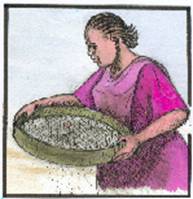
Before commencing the session, make sure that you have a sieve (like a
flour sifter, for example). When the group is assembled, you announces that you
are going to give a little demonstration. You take the sieve, put a bit of dust
into it, and sift the dust over the mat until there is a small mound of “good”
dust to show. The dirt remaining in the sieve must not be discarded right away.
The following questions are then asked:
¨ What’s in the sieve? (Answer: Twigs and pebbles we wanted to separate from the dust);
¨ What are we going to do with them? (Answer: Throw them away, get rid of them). At this point, one can empty the sieve.
¨ And what about the fine dust on the mat? (Answer: It’s clean; it’s what we wanted to keep).
¨ What is the purpose of the sieve? (Answer: it separates the good from the bad, the useful from the useless, etc.).
Explain now that together, you are going to study ways of “sifting” ideas in the next six or seven sessions. These six "tests" will serve to identify the tools and technologies that will enable them to improve the environment and to get closer to the goals the community has set for itself. Indeed, it is essential that people keep their goals in mind when they must choose from among different tools and technologies.
Ask the group what criteria they are accustomed to using when they have to decide on an action (or a tool) intended to solve problems faced by the village. The group will probably put forth one or two criteria along these lines: “Do we have the resources to carry out this or that technique?” or “Are we familiar enough with this technique to be able to apply it correctly?" It doesn’t matter now many ideas the group presents.
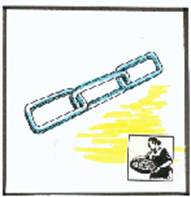
Then display the icon of the “management tools”instructional unit and indicate that the “testing guidelines” symbol will be the sieve used at the beginning of the session. Conclude the introduction by saying that the first test to be studied should enable them to recognize with confidence the thing that is really not working, i.e., the weak link, so as to be able to strengthen it.
Finally, announce that the group will develop the first “sieve” or “testing guideline” by playing the “weak link game”.
MODULE # 17TESTING GUIDELINESTHE WEAK LINK
|
|
|
PEDAGOGIC ANALYSIS
Desired situation:
¨ Members of the herding community are familiar with identifying the weak link, or the limiting factor, in the development of its activities;
¨ The community can identify this weak link throughout the whole chain, from the sun to the plant (i.e., the vegetation link), to the animal (i.e. the stockraising link), and to the animal’s exchange for money (i.e., the marketing link.)
¨ It is able to select tools and technologies that can rectify this particular shortcoming, and this one only.
Current situation:
¨
Lacking the ability to identify
the limiting factor, herders assign the same weight to all factors, and things
to be strengthened are chosen at random.
Disparity between current and desired situation:
The inadequacy that the module should correct is therefore the following:
¨
Herders and communities often
make important decisions randomly (on the basis of habit or advice from
neighbors), without making a serious effort to identify the limiting factor
which, if it were corrected, would enable them to make a real improvement in
the situation.
¨
Objectives of the module:
By the end of the session, participants shall be able to:
¨ Describe, on the one hand, the various links in the solar energy chain (i.e., sun, vegetation, livestock, exchange for money) and, on the other, the four building blocks of the ecosystem;
¨ Identify, within this same solar energy chain, the limiting factor, or “weak link”;
¨ Explain why that link, and only that one, is in need of strengthening.
LOGISTICS
Target group:
Given the overall impact of the modules that concern testing guidelines, it may be worthwhile to involve the entire community and to have all its constituencies represented, including:
¨ men and women;
¨ young people and the elderly;
¨ herders and farmers, etc.
|
|
|
|
|
|
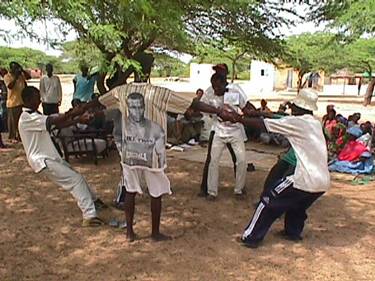
Yong people in the village play the “weak link” game, which consists of getting the weakest participant to let go of the chain. 26/01 |
|
Exercise utilized by the module:
the so-called “weak link” game
Graphical support materials:
Folder # 17
q Variant: Building blocks of the ecosystem
¨ Four to eight small cardboard placards (measuring about 10 x 10 cm) are attached to loops of thin string about 30 cm long;
¨ The icon for each of the four building blocks of the ecosystem is glued to each placard:
ü Water cycle (small cloud)
ü Organic matter (pile of cow manure)
ü Ecological succession; (rabbit)
ü Energy flow (sun)
¨ When there are eight players, two copies of each icon are glued onto the placards;
¨
Players put the string loops of
their placards around their right wrists, and then join hands.
q Variant: solar chain
Same materials, but the icons are used differently:
ü Transformation of solar energy into vegetation (shown by a sun and a plant);
ü Transformation of the plant into animal form (shown by a cow nibbling a plant);
ü
Transformation of the animal
into money (shown by a merchant handing cash to the herder.
Approximate duration of the module:
1 hour
IMPLEMENTATION
1. The “weak link” game: preparing the players (10 minutes)
According to the variant to be chosen (solar chain or building blocks of the ecosystem), ask those present to designate six to eight volunteers to play the “weak link” game.
¨ The players join hands and form a circle, keeping the placards showing the link they represent hanging from their right wrists;
¨ The players will first tend to form a fairly tight circle. Ask them to take a step backward, then another and another, in order to enlarge the circle until the chain is about to break;
¨ Specify that the players must let the chain break naturally; this is not a contest of strength among the participants;
¨ When it is clear that one of the players is going to let go of the person next to him and break the chain, stop the game momentarily and ask players to come back towards the middle to begin again.
2. Identification of the weak link: (10 minutes)
Resume the game, asking those present to guess which player will be first to let go, thus becoming the “weak link”.
¨ You walk around behind each player and ask the participants who are watching to raise their hands it they think that the person behind whom he is standing will turn out to be the weak link.
¨ Once the “bets” are in, the players once again start to move backward.
¨ The game ends when the chain breaks. The person holding the placard in the spot where the chain broke is identified as the weak link.
¨ Ask who, among the observers, correctly identified the “weak link”.
3. Strengthening the "weak link" (5 minutes)
Play the game again, but this time ask another participant to help the person who was the weak link the first time around. (He does this by standing right behind this person and hanging onto the adjacent person.)
The game stops when the chain breaks again at another spot or “weak link.”
4.Utilization of the game (10 minutes)
Ask the group a few questions to help people understand what happened and the point of the exercise:
¨ Did the participants correctly identify the person who would let go (i.e., the weak link)?;
¨ If a player other than the one they bet on ended up letting go, would it have been useful to have the person they chose be helped by a comrade (i.e., to strengthen the player who turned out not to be the “weak link”).
¨ If the guesses were accurate, is it normal for there to be a new weak link once the first one has been strengthened?
5. Discussion of the real-life situation: (10 minutes)
q
Variant: building blocks
of the ecosystem:
Remind the group that the ecosystem functions like a set of blocks (“ecosystem’s building blocks” .instructional unit) The blocks are interconnected, and when one block is not working properly, the chain breaks at that spot. Continue the discussion by asking, for example, the following questions :
¨ Have you already thought to identify the weak link in your ecosystem when you are planning to exploit your environment?
¨ What is the danger of failing to identify the weak link?
¨ What is the utility of strengthening something other than the weak link, or the limiting factor?
¨ Does it ever happen that one is wrong about the weak link and strengthens something that does not need strengthening?
q
Variant: solar energy
chain
¨ Is there any point in improving the breed of animals in the herd when the herd is in fact unproductive because it is malnourished?
¨ Is it useful to improve pasturage if it is then impossible to sell the animals under favorable circumstances?
¨ Etc., etc.
6. Application to the group’s environment: (10 minutes)
Give participants a few minutes to perform the following task:
¨ Describe the building blocks of their ecosystem (ecological succession, water and nutrient cycles,and energy flow);
¨ Try, amongst themselves, to identify the weak link, or limiting factor, in their ecosystem;
¨ Present their point of view.
7. Conclusion and transition (5 minutes)
¨ Ask participants to recap the most important points they retained from the game and the discussion of the weak link in their environment.
¨ Agree with the group on an icon that can be used to represent “the weak link” testing guideline during the rest of the training. (A picture of a few links of a chain will suffice.)
¨ Show again the “sieve” icon representing the “testing guidelines” instructional unit, and explain that there are five other sieves through which tools and technologies must pass. The next “sieve” will consist of making sure that this tool will correct the root cause of a given shortcoming, and not just its effect.
NOTES TO THE FACILITATOR
q
The notion of a “weak link”, or
limiting factor, is essential in biology. Although it is a bit abstract, it is
easy to get people to understand that it is pointless to correct anything if it
is not the cause of a given defficiency For example, there is no point in
improving the food or water of a cow, in housing her in a better barn, or in
breeding her to a better bull, if she is in poor health. The weak link here is
sickness, and the first thing to do is to treat that.
q Younger players tend to think that the “weak link” game is a contest of strength. This can make for an entertaining game, but it also makes the facilitator’s job more difficult. Make sure that the players agree to let the chain break while they take one step backward at a time.
MODULE # 18TESTING GUIDELINESCAUSE AND EFFECT |
|
|
PEDAGOGIC ANALYSIS
Desired situation:
In order to be able to manage its resources properly once the skills-development program has been implemented, a community must be able to do the following:
:
¨ They must first make sure, when they decide to apply a tool or a technology, that they are getting at the cause of a given defficiency they want to correct, instead of simply attenuating its effects
¨ They must therefore have developed an ability to distinguish between cause and effect.
Current situation
In reality, however, the situation is most often the following:
¨ There is very frequent confusion between cause and effect;
¨
The general tendency is to
correct effects, rather than causes, since that calls for immediate,
easily-applied solutions that yield quick results, rather than to rectify
causes, which are deeper and demand longer-term action.
Disparity between current and desired situation
This module should therefore fill this gap by :
¨ Clearing up the analytical difficulty that prevents people from making the distinction between cause and effect in the choice of tools
¨ Persuading people that as long as root causes are not addressed, no problem can be solved, and that causes, not symptoms, should be the focus.
Objectives of the module
By the end of the session, participants shall be able to:
¨ Distinguish between cause and effect in a given situation;
¨ Explain what happens if one addresses solely the effects, neglecting the true causes of a given situation.
|
|
|
|
|
|
The facilitator displays images from the « cause and effect » module to the villagers of Keur Martin 28/05. |
|
LOGISTICS
Target group:
Given the overall impact of the modules that concern testing guidelines, it may be worthwhile to involve the entire community and to have all its constituencies represented, including:
¨ men and women;
¨ young people and the elderly;
¨ herders and farmers, etc.
SARAR exercises utilized by the module:
¨ Adaptation of the "critical incident" exercise (Srinavasan, p.110)
Graphical support materials:
Folder # 18
¨ About a half-dozen cardboard cards (postcard format) representing various objects
¨
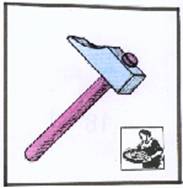
“Cause and effect”
icon (a hammer).
Approximate duration of the module:
30 minutes
IMPLEMENTATION
1. Introduction to the module (5 minutes)
Introduce
the session by reminding those present of the first “sieve” that was studied,
i.e., that of the “weak link”. This session will look at a second
“sieve”, i.e., “cause and effect”.
4. The “cause and effect” game (5 minutes)
¨ Introduce the game by displaying the image of a person being hit by a hammer, and make sure that everyone has understood the image.
¨ Make sure that the group has clearly understood that the “cause and effect” picture game is not an unserialized posters exercise, but that the idea is instead to choose, from among the images, the one that represents the best solution to the person’s problem.
¨ Ask a volunteer to put the image cards down, one by one, on the mat in front of the group.
¨
Next, ask participants to say
which card(s) show a solution that might solve the person’s problem.
5. Utilization of the game (20 minutes)
Help participants to make the connection between the outcome of the game and the importance of the testing guideline, by asking the following questions, for example:
¨ Why the card showing two hands that prevent the arm from continuing to administer hammer blows, is the right one?
¨ As long as one keeps hitting the person over the head, it is possible to solve his problem? Why?
¨ What conclusions can one draw from this game?
6. Conclusion: relationship between the game and real life (5 minutes)
· Can the group cite examples of situations in which there was an obvious confusion between a problem’s cause and its effects?
· Why is the distinction between cause and effect so important?
· For example, is the replanting of vegetation on a pasture where it has been destroyed by poor grazing management going to solve the problem if one does not, first of all, better control herd movements? Why?
· What is the danger of failing to make the distinction between cause and effect? (Cf. the second point of the “current situation” under the pedagogic analysis)
· Lessons to be drawn from the exercise in terms of attitude and behavior.
7. Transition
¨ Agree with the group on an icon that can serve to represent the “cause and effect” test during the rest of the training. (A hammer will do, since everyone will readily recall the hammer blows.)
Now that the group has studied two of the six “sieves” to be used when making a decision, the next “sieve” will help them see how the envisaged tool can affect the whole ecosystem.
MODULE # 19TESTING GUIDELINESECOSYSTEM AS A WHOLE
|
|
|
PEDAGOGIC ANALYSIS
Desired situation:
In order to be able to manage its resources properly once the skills-development program has ended, a community must be able to :
:
¨ Take into account, in choosing tools and technologies to be implemented, their impacts upon the various building blocks of the ecosystem, on ecological succession and on the stability of the ecosystem.
Current situation
The reality, however, is more often that :
¨ New tools and technologies are chosen without regard for their adverse impacts on the overall ecosystem (e.g., pesticides, monoculture, etc.)
Disparity between current and desired situation
The module is therefore intended to fill in the following gaps:
¨ Ignorance of these tools’ negative impacts on the ecosystem;
¨ Disregard of these effects, even when they are known.
Objectives of the module
By the end of the session, participants shall be able to :
¨ Explain the impact of the tool on the building blocks of the ecosystem;
¨ Explain how certain decisions can have a negative impact on the ecosystem;
¨ Explain why one must first study how the ecosystem reacts to the application of each tool.
LOGISTICS
Target group:
Given the overall impact of the modules that concern testing guidelines, it may be worthwhile to involve the entire community and to have all its constituencies represented, including:
¨ men and women;
¨ young people and the elderly;
¨
herders and farmers, etc.
SARAR exercises utilized by the module:
the "whole ecosystem" game
Graphical support material
Folder # 19
¨ The four icons representing the four building blocks of the ecosystem used previously in instructionalunit three: “ecosystem’s building blocks”.
Duration of the module:
30 minutes
IMPLEMENTATION
1. Introduction: (10 minutes)
The
focus here is the third “sieve” to be studied. It is particularly important
because one has to be sure that the tool or technology that one plans to use
will actually correct the “weak link” identified among the four building blocks
of the ecosystem.
You might explain the game in the following way: the group will test a few tools, gauging the impacts they might have on each building block of the ecosystem. How ? By letting the four building blocks of the ecosystem speak for themselves.
2. The “Ecosystem impact” game: (10 minutes)
· Ask for four volunteers to represent each block of the ecosystem. Give each one the icon corresponding to the block he represents. He will hold the icon in front of him during the game.
· Agree with the group on specific “weak links” which should be addressed with each of the ecosystem’s building blocks, one after the other;
· Ask the members of the group who wish to test a given tool to address this specific “weak link” to come up and present the tool he recommends before each block, explaining why this tool should help reinforcing the “weak link” and attain the desired goal.
· Each block then must explain why he does or does not accept the tool.
· Go through two or three “weak links” before concluding the game.
· Invite applause and thank the players.
3. Utilization and conclusions: connection with real life (10 minutes)
Induce participants to make the connection between the game and the importance of the testing guideline, by asking the following questions, for example:
· What happened with the first tool that was suggested? Why was it accepted/rejected? (ditto with the second and third tools.)
· What might happen if one applies a tool without first considering its impact on the ecosystem?
· Which part of the goal is this test particularly relevant ? (Answer: landscape goal).
·
What lessons can one learn from
this module in terms of attitudes and behaviors ?
Can the group give examples of situations in which the effect of a tool on the overall ecosystem was not taken into account? What happened? (Examples: use of pesticides leading to the disappearance of insects, then birds, etc.)
4. Transition
¨ Agree with the group on an icon that can stand for the “ecosystem as a whole” sieve during the rest of the training. The symbol of the four building blocks of the ecosystem – the four pillars of a dwelling – is mentioned again.
¨ Tell the group that the next “sieve” will allow them to be sure that the resources (e.g., money and labor) devoted to deploying the tool or technology under consideration would yield more benefit than if they were used to put another tool ortechnology in place.
NOTES TO THE FACILITATOR
q
The purpose of these notes is
to provide two examples showing how two different tools (i.e., fire and animal
impact) can be subjected to the “ecosystem as a whole” testing
guideline, so as to help you better control the performance of this module.
q The question the group must ask itself is this: how will each of the building blocks of the ecosystem react to the use of a particular tool? The following are only examples, since the reaction of the blocks of the ecosystem depends on each particular situation and on the landscape goal being pursued.
q Example 1: Fire:
In
arid regions, fire “consumes” plant matter and exposes the soil (creating bare
earth). This soil, when acted upon by rain and wind, is subject to erosion and
can be carried away by torrential runoff. In addition, fire heats up the soil,
destroying micro-organisms needed to decompose organic matter. Thus, in most
cases, fire has a negative impact on the blocks of the ecosystem in arid
regions.
q Example 2: animal impact
Animals have the ability to break up the hard-packed soil crust with their hooves, thus encouraging water percolation and improving the water cycle. Livestock also enriches the cycle of organic matter by contributing manure. However, if animals are kept too long in the same part of the grazing area, they will tend to compact the soil and overgraze the plants.
MODULE # 20TESTING GUIDELINESADDITIONAL RESOURCES
|
|
|
PEDAGOGIC ANALYSIS
Desired situation:
¨ Herders are able to gauge the relative efficacy of apportioning additional resources (e.g., labor, money) to the various aspects of its activity, and to act accordingly in choosing tools and technologies.
Current situation
The reality, however, is often the following :
¨ Decisions concerning the allocation of additional resources (or marginal resources, in economic parlance) are made empirically, without regard for the relative efficacy of this allocation in terms of overall activity.
Disparity between the current situation and the desired situation
This module is therefore intended to fill the following gaps :
¨ Ignorance of the nature of limiting factors and of benefits resulting from the strengthening of each one;
¨ Inability to identify the best opportunities for allocating resources.
Objectives of the module
By the end of the session, participants shall be able to:
¨ Describe the various possible ways to allocate additional resources (e.g., improvement of vegetation, of stockraising, or marketing);
¨ Identify the allocation that would appear to yield the greatest benefit.
|
|
|
|
|
|
Volunteers playing the « additional resources » game stand behind the investment they would choose, waving their cash. 28/09 |
|
LOGISTICS
Target group:
Given the overall impact of the modules that concern testing guidelines, it may be worthwhile to involve the entire community and to have all its constituencies represented, including:
¨ men and women;
¨ young people and the elderly;
¨ herders and farmers, etc.
SARAR exercises utilized by the module:
Adaptation of the ”pocket chart" exercise (Srinavasan, p. 93)
Graphical support material
Folder #20
¨ About a half-dozen images (A4 format) of what might be acquired with additional resources;
¨ About twenty black and white photocopies of bank notes
¨ “additional resources” icon (bank notes.)
Approximate duration of the module:
1 hour
IMPLEMENTATION
1. Introduction to the game (10 minutes)
¨ Explain to the group that the exercise consists of continuing the review of "testing guidelines" (or “sieves”) that must be taken into account in choosing how to deploy new resources (e.g., labor or money) in the area of livestock raising or any other activity.
¨ Ask participants to recall a recent experience in which they had to decide to adopt a new “tool” involving a substantial amount of time or money;
¨ The exercise aims to demonstrate how important it is to make accurate calculations and to justify one’s decision correctly. To the extent that resources are rare, care must be taken that they are used for the deployment of the cheapest tool, in relation to the anticipated results.
2. Investment game (10 minutes)
¨ First, agree with the group on the nature of the limiting factor (or weak link) that needs to be corrected in order to move closer to the community’s goal. For instance, if one considers the solar energy chain, does plant cover needs to be improved? What about herding? The sale of animals? Or, if one considers the blocks of the ecosystem, which block is the deficient one?
¨ If participants are hesitant, suggest different ways of providing drinking water to animals:
ü With a bucket
ü Using animal power
ü Manual pump
ü Wind pump
ü Motor pump, etc…
¨ Next, present the images representing the various ways of using additional resources, and choose those that are most closely associated with the weak link that has just been selected for improvement, explaining that these images represent the various possible options in a given situation.
¨ The exercise consists of examining together these different investment possibilities, in order to decide which tool is cheapest and will produce the greatest impact on the weak link that was identified at the beginning of the game.
¨ Ask four volunteers to stand facing the group, and give each volunteer one of the tool images, which he will hold up in front of him.
¨ Ask a few volunteers to play the role of “investor”, to whom a few copies of bank notes are given. Each one lines up behind the tool he feels is the best, given both the goal being pursued and the relative efficacy of the proposed tool.
¨ Once the “investors” have made their choice, ask each one in turn to give the reasons for their choice.
¨ Go into more detail if necessary by asking questions that might point up “hidden” costs that the “investors” may have overlooked.
3. Utilization of the game (30 minutes)
Help participants to make the connection between the outcome of the game and the importance of the testing guideline by asking the following questions, for example :
¨ Which investors chose the right tool? Why was it the right one ?
¨ What consequences await investors who have underestimated costs or overestimated benefits ?
¨ An example: is the purchase of an additional animal most justified if one has assessed that the weak link is inadequate productivity of grazing lands during the dry season ?
4. Conclusion and transition (10 minutes)
¨ Can the group provide examples of situation in which a decision was made to adopt a new tool without taking the “additional resources” testing guideline into account, and in which this decision resulted in a failure ?
¨ Agree with the group on an icon that can stand for “additional resources”” during the rest of the training. A picture of bank notes may suffice.
MODULE # 21TESTING GUIDELINESEXTERNAL
DEPENDENCY
|
|
|
PEDAGOGIC ANALYSIS
Desired situation:
In order to be able to manage its resources adequately upon completion of the capacity-building program, the community must have the following capability:
:
¨ ability to base decisions concerning the adoption of tools and technologies on the community’s capacity to ensure their implementation, their operation and their maintenance.
Current situation
In reality, however, the situation is often the following :
¨ Herding communities are inclined to accept new infrastructures and equipment (in the form of subsidies), without figuring out how they will continue to be used in the long run;
¨ There is a fascination with sophisticated equipment, which doen’t always take into account their sustainability;
Disparity between current and desired situation
The gap that must therefore be bridged by means of this module is the following:
¨ The community is not sufficiently committed to a dynamic of autonomy and self-management.
Objectives of the module
By the end of the session, participants shall be able to:
¨ explain how they intend to ensure the sustainability of the investments they envisage, using their own resources instead of relying on external support (e.g., subsidies).
LOGISTICS
Target group:
Given the overall impact of the modules that concern testing guidelines, it may be worthwhile to involve the entire community and to have all its constituencies represented, including:
¨ men and women;
¨ young people and the elderly;
¨ herders and farmers, etc.
|
|
|
|
|
|
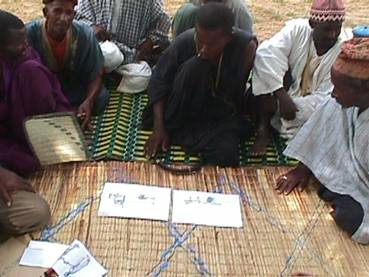
The men of the small village of Keur Martin ( Senegal) ponder the meaning of pictures distributed to illustrate the module: a donkey and a truck. (29/06) |
|
SARAR exercises used in the module:
Structured exercise
Graphic supports:
Folder # 21
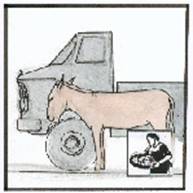
¨ Images (in postcard format) representing a small truck, a donkey with a cart, and the things needed to make each one work.
¨
“External dependency”
icon (showing a small truck and a donkey)
Approximate duration of the module:
45 minutes
IMPLEMENTATION
1. Introduction to the game (10 minutes)
¨ Begin by reminding the group that they are now going to study the fifth testing guideline, or “filter”, which involves determining the extent to which a new tool, and particularly its use over time, should not be excessively dependent upon external support and/or financing;
¨ Show images of the donkey and the truck, emphasizing that each of these “technologies” requires supplies and maintenance in order to function;
¨ Ask participants to identify what is needed to maintain each “technology”;
¨ For each new need mentioned, show the corresponding (postcard) image. For example, the group will mention :
|
For the donkey |
For the truck |
|
Bales of hay Water |
Tires Lubricant Fuel Motor oil Driver Spare parts Insurance Registration Etc. |
2. Using the game (30 minutes)
Get the group to see the connection between the responses provided and the external dependency testing guidelines, by asking, for example, the following questions:
¨ How much might it cost to maintain the truck?
¨ How much might it cost to maintain the donkey?
¨ Where do the funds for the donkey’s maintenance come from? What about the truck?
¨ What happens if spare parts or fuel are no longer available?
3. Conclusion: linkage with the actual situation (5 minutes)
¨ What conclusions can one draw about external dependency, in connection with the choice of tools?
¨ Can the group give examples of situation in which a community failed to take external dependency into account? What were the consequences?
¨ Next, agree with the group on a symbol or "icon", e.g., the images of the small truck and donkey, that will stand for external dependency and sustainability for the rest of the outreach exercise.
4. Transition to the next module (5 minutes)
¨ Inform the group that the last testing guideline, or “filter” that should be applied to any new tool or technology before it is used is one that is very often forgotten, with serious repercussions: Has it occurred to them to wonder whether this new tool or technology is compatible with the culture of the society concerned?
MODULE # 22TESTING GUIDELINESSOCIETY AND CULTURE
|
|
PEDAGOGIC ANALYSIS
Desired situation:
In order to be able to manage its resources adequately by the end of the capacity-building program, a community must make sure that:
:
¨ its decisions take into account, and are compatible with, the community’s social characteristics (i.e., traditions, customs, etc.) and that they contribute to greater social equity.
Current situation
In reality, however,
¨ community decisions are not always based on the opinions of all constituencies.
Disparity between current situation and desired situation
The gap that must therefore be bridged by means of this module consists of the fact that:
¨ traditional societies do not always consider the opinions and interests of the community’s various stakeholders (e.g., women, young people, certain ethnic groups, castes, etc.), and particularly those of other communities (e.g., neighbors, transhumant herders, etc.).
Objectives of the module
By the end of the session, the participants shall be able to:
¨ identify the actors and social groups within the community that would be affected by the proposed tool or technology;
¨ evaluate the acceptability of a given action to the various stakeholders and social groups affected, both inside and outside the community.
LOGISTICS
Target group:
Given the overall impact of the modules that concern testing guidelines, it may be worthwhile to involve the entire community and to have all its constituencies represented, including:
¨ men and women;
¨ young people and the elderly;
¨ herders and farmers, etc.
SARAR exercises used by the module:
Role-playing, with or without “maxi-flans” characters;
Graphic supports:
Folder # 23
¨ If the role-playing is done with large character's faces (maxi-flans), about a half-dozen of those;
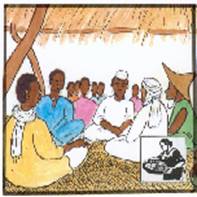
¨ "Society and culture" icon (villagers gathering under a tree);
Approximate total duration of module:
45 minutes
|
|
|
|
|
|
|
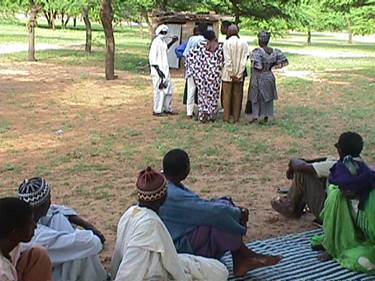
The facilitator stands apart from the group with the role-players, to work out the roles of each character with them . (28/12) |
|
|
IMPLEMENTATION
1. Introduction (5 minutes)
This is the sixth and last testing guideline, which unlike the others, is not purely technical, but nonetheless very crucial. Explain once more the concept of role-playing (as a “little theater”) and indicate that a brief story will first be told to provide the backdrop for the role-playing.
2. Role playing (15 minutes)
q Subject of the role-playing
|
One day, the herders of the little village of Niangaré decided they were tired of seeing their pastureland steadily deteriorate and their animals become thinner and thinner because they had less and less fodder to graze on.
The village chief sent his eldest son to the nearest town, telling him to get some answers from the Administration or some other organization.
The son returned to the village with a very nice technician who spent a day in the village and declared that Niangaré’s grazing lands were deteriorating because they were supporting too many animals: i.e., not only those belonging to the villagers, but also those belonging to transhumant herders who passed near the village on their way to and from the salt licks.
The technician advised that Niangaré’s pastures be fenced off with barbed wire, which his NGO would be prepared to finance.
The villagers accepted the fencing-in of their pastures enthusiastically, hoping that this would be the solution to all their problems. They were so happy that they forgot to say that the transhumants who crossed their pastures had been doing so for generations, and that they had always enjoyed very cordial relations with them.
The week after the fence was installed, a herder who was not from the village fought with the son of the village chief, who wanted to prevent him from entering the pasture. The following week, the fence was found destroyed and the fence posts pulled out, up to the boundary with the neighboring village.
By the third week, the conflict had grown so serious that the District Commander had to pay a personal visit to the village to settle the issue.
|
q Characters in the role-playing exercise
Group members shall assign the following roles:
¨ the village chief, who explains that the fence was installed to protect the pastures;
¨ his son, who appears not to know, or not to remember, that the neighbors were accepted by the villagers in the past;
¨ the herdsman from the neighboring village with whom he quarreled, who says that he has always grazed his animals on this pasture and that no one can prevent him from doing so;
¨ the district commander who tries to resolve the problem;
¨ possibly, the technician from the NGO that financed the construction of the fence.
q Preparation for role-playing
Outline the proposed scenario to the group of "actors", and ask them to work out amongst themselves who will play which character. Once the “actors” are identified, take them aside and explain each one’s role. Provide clarification, if needed, and give them 15 minutes to prepare their lines.
¨ Before the "actors" begin to perform, ask them to state which characters they are going to play.
¨ Clearly identify who is playing which role, so that the audience can follow the plot easily .
¨ Ask the "actors" to perform for about 5 to 10 minutes.
¨ When they have finished, thank them and have the “audience” applaud them.
3. Using the role-playing exercise (20 minutes):
Get the group to understand the connection between the message of the role-play and the “society and culture” testing guideline, e.g., by means of the following questions:
¨ What happened in the story?
¨ What started the conflict?
¨ Why did the transhumant herders destroy the fence?
¨ Would it have been better if the community of Niangaré had talked to the transhumant herders before putting up the fence?
¨ What happens when one chooses a new tool or technology and forgets to take into account the population’s mores, customs, concerns and experience?
4. Conclusion: linkage with the current situation (5 minutes)
¨ Can the group give a few examples of situations in which the choice of new tools or technologies were not subjected to the "society et culture" filter?
¨ What were the consequences?
¨ Agree with the group on a symbol or “icon” e.g., the image of a village meeting under a tree, that will be used to represent "society and culture" for the rest of the outreach cycle.
5. Transition to the next module (5 minutes)
¨ Congratulate the group on having covered the six testing guidelines or “filters” that will play such an important role in the future, when they will need to choose the best tools or technologies to be implemented, aiming at managing their resources in accordance with their own goals.
¨ Point out to them that many more criteria have been covered than they had initially imagined when the “filtering” of ideas began .
¨ Acknowledge that this is a complex process that demands quite a bit of thought, and requires that one takes into account many factors that are usually forgotten;
Tell them that this is why the following session will study how one might, in an entertaining way, come up with a method of ensuring that all "filters" are used appropriately to ensure that the decisions made are the best ones possible.
MODULE # 23TESTING GUIDELINESSYNTHESIS
|
|
|
PEDAGOGIC ANALYSIS
Desired situation:
In order to be able to manage its resources adequately by the end of the capacity-building program, a community must be able to proceed in the following manner:
¨ Each time it finds itself in a position of having to make a decision or choose a new tool or technology, as well as the corresponding investments, the community must automatically resort to the battery of six testing guidelines (a.k.a., the “filters”) that it has learned to use.
Current situation
In reality, however, the situation is often very different:
¨ Actions to be undertaken are chosen randomly, and even in cases where one or two criteria are taken into account, this is not the result of a rigorous methodological approach.
Disparity between current and desired situation
The gap that must therefore be bridged by means of this module is the following:
¨ Lack of awareness of the need to use the battery of testing guidelines so as to gauge the relative merits of the various tools and technologies that might be used.
Objectives of the module
By the end of the session, the participants shall be :
¨ capable of explaining why it is necessary to test new actions before deciding to implement them;
¨ familiar with the battery of testing guidelines and willing to use them systematically.
|
|
|
|
|
|
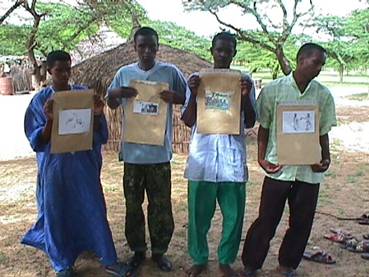
Young people hand out envelopes containing the various tests to members of the group who want to decide on the acceptability of one tool versus another. (29/07) |
|
LOGISTICS
Target group:
Given the overall impact of the modules that concern testing guidelines, it may be worthwhile to involve the entire community and to have all its constituencies represented, including:
¨ men and women;
¨ young people and the elderly;
¨ herders and farmers, etc.
SARAR exercise used by the module:
Pocket chart (Srinivasan, p. 93)
Graphic supports:
Folder # 23
¨ 6 envelopes placed next to each other so as to present a “pocket chart";
¨ the 6 icons representing the testing guidelines for the choice of new tools or technologies;
¨ about forty small pieces of paper (business card size).
Approximate duration of the module:
1 hour
IMPLEMENTATION
1. Introduction (10 minutes)
¨ Explain to participants that, up to now, they have studied the six testing guidelines, or filters, with which every new tool or technology must be evaluated before being adopted, in order to be sure that it will further their goals;
¨ Since using these testing guidelines require a lot of work and the manipulation of a lot of information, an exercise has been developed to ensure that none of the testing guideline is forgotten;
¨ The following module thus represents the synthesis of the six previously-studied modules, and will organize them in such a way as to be sure that each has been adequately covered.
2. “Pocket chart” exercise (30 minutes)
¨ Ask the group to name the six testing guidelines or “filters” that they have studied. Each time a new test is cited, ask the participant to explain it briefly. If the explanation is correct, hand that person the envelope bearing the icon of the test in question.
¨ Once the envelopes illustrating the six testing guidelines have been distributed, they can either be attached to the flip-chart easel or taped to the wall, or six participants can be chosen to hold them out in front of them, so as to present what we shall call a “pocket chart”. The main thing is for everyone to have an unobstructed view of this.
¨ At this time, an agreement will need to be reached on the "weak link " to be reinforced by means of the tool to be evaluated, either within the solar chain (e.g., vegetation, animals, money), or one of the four ecosystem’s building blocks (cycles of water, nutrients, succession, overall ecosystem), or yet again at the level of the three hearth’s stones of the holistic goal (quality of life, production, landscape).
¨ The group must be aware of the fact that no tool can be evaluated in and of itself: it must instead be evaluated in relation to the community’s holistic goal.
¨ Identify, from among the tools and technologies considered under the preceding exercises, those that could be tested as a function of this goal: e.g., purchase of a cow, or a tractor, buiding a fence, using livestock impact, performing vaccinations, purchasing fodder, etc.
¨ Ask participants to select one of these tools, or another of their choosing, and explain how it will be subjected to the six testing guidelines. The procedure (which may be repeated several times) is the following:
|
1. Ask for 10 volunteers (players) for this exercise, and give each player six small pieces of paper. 2. Ask the players to take turns coming up to the pocket chart and assessing the chosen tool or technology through each of the six testing guidelines in turn. If the player thinks that the tool or technology has passed a test, he puts one of his pieces of paper into the corresponding envelope. If he does not think it passes the test, he does not put a piece of paper into the envelope, but keeps it instead. 3. Once the 10 players have given their point of view for the six tests, count the number of slips of paper deposited in each envelope. 4. It is obvious that the proposed tool or technology has not passed the tests if it has been approved by less than two or three players out of ten. Ask them to explain why they rejected it. 5. If the group hesitates (e.g., half of the group feels that the tool or technology has passed the test, while the other half disagrees) ask the players to discuss amongst themselves and to come up with a group decision. 6. The tool or technology is accepted when it has passed the six tests.
|
3. Conclusion: linkage with real life (15 minutes)
¨ Was it easy or difficult to approach the testing guidelines this way ?
¨ Which testing guideline is the most difficult to master? Why?
¨ What happens when one applies a tool without having tested it?
¨ How does a reflection process like this one make decision-making easier?
¨ Was the tool chosen as a function of the goal (quality of life, production, landscape) defined and pursued by the community?
¨ Has anyone in the group ever used a technique of this kind before making a decision in real life ?
¨ What lesson can one derive from this exercise ?
4. Transition to the next module (5 minutes)
¨ Conclude by reminding participants that the “icon” of the” testing guidelines” synthesis module is, of course, the one that represents the testing guidelines instructional unit:, i.e., the filter.
¨
Tell that group that they have
now studied five instructional units covering:
§ The "whole to be managed”
§ The "holistic goal" (represented by the three stones on the hearth)
§ The " ecosystem’s building blocks " (the four pillars of the house)
§ The six "testing guidelines" (the filter)
The group is now ready to use these new instruments to plan the utilization of their resources, which will be the subject of the following instructional units.